
At a Conference in Prague
I visited Prague in July 2022 because a large Tibetological conference (the 16th International Association of Tibetan Studies Seminar) was taking place there. It felt wonderful after the long pandemic to be able to gather together in a real location, at Charles University, instead of just staying at home and staring at a Zoom meeting on the screen. In addition to reuniting with many scholars there, it was especially great to have the opportunity to meet the Tibetan poet Kelsang Lhamo (b. 1973), with whom I had exchanged email messages but never before met in real life.
I met Kelsang Lhamo on the first day of the conference by the table of the Buddhist Digital Resource Centre (BDRC). This organization had an info point in the corridor near the lecture halls, where scholars could receive advice on how to use its digital collections [1]. I have translated some of Kelsang Lhamo’s poems [2] into Finnish, and in my talk at the conference I also presented on her poetry, so it was great to finally be able to meet this poet and writer, who lives in Boston and works at the BDRC and was participating with its team at the conference. We decided to meet the next afternoon and go somewhere to dine where I could interview her. The next day we went to eat at an Indian restaurant, and I had the chance to ask her questions and hear about her writing and, more generally, her interest in Tibetan literature.
Early Influences from the Songs of the Sixth Dalai Lama
When I interviewed Kelsang Lhamo, it became evident that she has received great inspiration for her writing from traditional Tibetan literature. Indeed, it appears that this Tibetan writer and poet living in Boston has not made use of Western culture as a source of inspiration or renewal for the Tibetan tradition, but consciously turns to her own tradition, making use of its writing styles and techniques. She is originally from Lhokha (Lho kha) in Tibet (Tibet Autonomous Region) from a rather small place in the area of Gongkar (Gong dkar), which is located near the retreat center of the yogi Ling Repa (gLing ras pa), called Naphu (gNa phu ri khrod), as well as Dorje Drag (rDo rje brag) monastery.
I asked Kelsang Lhamo how she started writing and about her first writings. She started to write at a quite early age, about twelve or thirteen years old. At that time she especially liked the songs of the Sixth Dalai Lama Tshangyang Gyatso (Tshangs dbyangs rgya mtsho). Those songs have now been published in print, but Kelsang Lhamo heard the songs from her parents and other people in her home region who used to sing them. Women sometimes also sang them as some kind of “competition,” taking turns singing, and some even invented their own songs. Kelsang Lhamo, too, started to sing and write her own songs, but these early songs were not published at that time. She told that she learned hundreds of songs by heart and wrote her own songs in the same style.
When Kelsang Lhamo was about 14 years old, she received the opportunity to participate in lectures organized by the literary magazine Lhokha’s Literature (Lho kha rtsom rig sgyu rtsal), where Dungkar Losang Thrinley (Dung dkar blo bzang ’phrin las) and some other lamas acted as teachers. Dungkar Losang Thrinley—who wrote a commentary on the Indian classical treatise on poetics, the Kāvyādarśa, which has been translated into Tibetan—was teaching poetry. Kelsang Lhamo comments that the opportunity to study literature also helped her to improve her own writing skills.
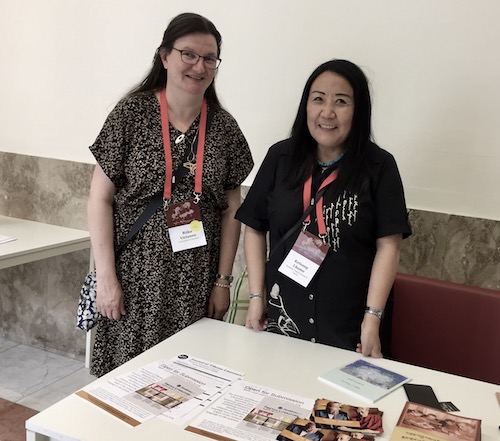
Kelsang Lhamo and Riika Virtanen at Charles University in Prague, summer 2022.
The First Published Book: “Dreaming at the Sage’s Abode”
Next we talked about Kelsang Lhamo’s first book and her life during its writing and publication. Her first book was written in India in Dharamshala. Kelsang Lhamo was still very young when she arrived in India from Tibet, being only sixteen years old. In the beginning she did not plan to stay in India, as she had only wished to see the Dalai Lama and Bodhgaya and then return back to her home region after the end of her holiday. But that did not happen. Seeing the Dalai Lama inspired her to become a nun.
In Dharamshala, Kelsang Lhamo lived in a house called Rishibhavan with some other nuns, and read and wrote a lot. She tells that she always wished to become a writer. Her first book Dreaming at the Sage’s Abode (Drang srong bsti gnas kyi rmi lam yun cig) was published by the Amnye Machen Institute in 1999. The book includes the stories of four nuns. In email messages with Kelsang Lhamo I had learned earlier that those are based on real-life stories, although the names of some of the nuns have been changed. Kelsang Lhamo spoke about the stories of nuns included in her book. The story of Pelmo (dPal mo) in the book is the life story of her late best friend. She wanted to write it because she felt that it was very special. She characterized the story of this friend as incredible and its main protagonist as very authentic and innocent. She told that when she thinks of this friend’s life, she feels deep sadness and joy at the same time.
Kelsang Lhamo described the life story of each nun in her book as being very remarkable. Sometimes she is asked why she chose just those nuns, and she tells that she holds the life stories of these nuns in particular to be deeply touching, even if it is true that each person has a story. Kelsang Lhamo commented on one of the stories, that of a nun from a family called Zhakabpa (Zhwa sgab pa), explaining that this nun had a very pleasant life when she was young but it was very difficult at the end. This was because she had become a nun; although the Zhakabpa family was quite large, when she became old no one took care of her, and her life was very lonely. Earlier, before she came to India, she had been in prison. Kelsang Lhamo added that it is sad to think about the difficulties that this nun experienced.
Kelsang Lhamo told that when she wrote her first book, she had not made a plan to do that or that it would be published someday. When she was in retreat at the Rishibhavan house, she wrote the stories of the nuns in notebooks and then just put them to the side. Because of the help she received from Pema Bhum and Tashi Tsering, that book was eventually published. At her place of retreat, there were also some students from Amdo. Kelsang Lhamo tells that there was also a person called Dorje Tsering, who brought Pema Bhum there. He then talked about Kelsang Lhamo’s writing with Tashi Tsering, who was working at the Amnye Machen Institute, which published books and a journal. Kelsang Lhamo remembered that those Tibetans who had recently arrived from Tibet felt close to each other, since they were so few at that time.[3]
Literary Models and Influences: Inspiration from the Tibetan Tradition
In order to understand more about the literary influences on Kelsang Lhamo’s writing, I asked about her literary models and sources of inspiration. We talked about books that have been important for her. She shared that she loves Peljor’s (dPal ’byor) novel gTsug g.yu (“The Turquoise Head Ornament”), which she brought from Tibet with her. When she traveled to India from Tibet, she had the songs of Milarepa, gTsug g.yu and Dragdong Treling Wangdor’s (Brag gdong bKras gling dbang rdor) novel bKras zur tshang gi gsang ba’i gtam rgyud (The Secret Tale of Tesur House). She carried them with her on the snowy mountains, and when she had to throw something away due to weight, she always discarded other things, like blankets and tsampa, but kept carrying the books. I told her that I have read those books and that they made a big impression on me, too.[4] Hearing how important the Sixth Dalai Lama’s songs were to Kelsang Lhamo in her youth, I asked if she had carried those songs with her as well. She replied that Tibetans always learn them by heart. Earlier those songs did not exist in written form, but people went to the countryside to collect them and then the songs were published together.
As an important source of inspiration, Kelsang Lhamo mentions Tsangnyon Heruka (gTsang smyon he ru ka), the writer of Milarepa’s biography. He wrote the life story of Milarepa 400 years after Milarepa lived in Tibet. Kelsang Lhamo explained that because of Tsangnyon Heruka’s work, Milarepa has become really well known. She describes the writing style of Tsangnyon Heruka as very deep, clear and meaningful. Words are so well chosen that not even a single one can be left out. Kelsang Lhamo was 12 years old when she read the life story of Milarepa written by Tsangnyon and learned it by heart. When the women gathered together in her native region, she told them the story of Milarepa. Kelsang Lhamo tells that she recently read the life story of Tsangnyon again, because she wanted to check a certain detail in it.
At Mount Kailash
Earlier, I noticed an interesting bit of information in Kelsang Lhamo’s profile on the BDRC website. There was mention of a work of poetry named “A Maiden’s Wandering Westward.” When I asked her about it through email, I got a reply that it had not yet been published. Later Kelsang Lhamo wrote me that she has over 300 short poems in her drawer. During our interview, Kelsang Lhamo discussed that literary work about wandering westward. Initially she traveled from Tibet to Nepal, and then from there went to India and from India again to America, where she has already lived 22 years. We talked about how interesting it would be if she could publish at least something from that early literary work. Among those poems are also ones that Kelsang Lhamo considers suitable for publishing, which were written at Mount Kailash. She returned in her memories to Mount Kailash, where she traveled after leaving school when only 15 years old. She stayed there for about three months and wrote a lot then. She reminisced how beautiful it was—at that time there were no tourists yet, contrary to today—and commented that if she looks at how she was writing in the 1980s and 1990s, her style of writing has not changed that much, except perhaps in regard to personal experiences, where her writing these days is a bit more in depth. Kelsang Lhamo explained that it could be time to publish her earlier works when she completes the task of writing the biography of E. Gene Smith.[5] During the conference the attendees got to see a proof of his life story, which she was checking before publication. She has written that book in Tibetan, and the English-language version is currently being developed, together with a translator.
About Writing
When we talked about writing, I asked how she goes about it. She answered that she writes with both pen and laptop, but using the latter started only in 2005 in America. She writes nearly daily, and she always keeps notebooks and also reads a lot of books. Sometimes it happens that she sees very interesting poems, which she adds to her notebook. She then tries to write in the same kind of style, describing it like learning to write, with those poems functioning as examples. She used the term dper brjod (“example”), which describes when Tibetans study poetry and the students write their own verses but follow the model of different verses. She does not read English poetry, as it still does not appeal to her feelings in the same way as texts written in her mother tongue. However, she has become acquainted with some English songs, like “Country Road,”[6] which she sometimes listens to and enjoys.
I asked Kelsang Lhamo what her advice might be for people who feel interested in writing. She advises them to choose from a larger amount of writings those that are suitable for publishing, because if one plans from the beginning to write something for publication, then it will not be authentic. She shared that she always writes what she thinks, and then she chooses later what will happen. If someone says that a certain piece of writing is good and that she should publish it, then she may consider it.
I asked what she thinks about life in the US. Kelsang Lhamo replied that life in the US is good and wonderful, citing as a special reason that there are a lot of types of social media. I was surprised at this and asked if she likes social media. She mentioned Facebook and WeChat. If it has been a day that has felt special, she shares some of her poems there. On Facebook she posted only in Tibetan, but she stopped a few years back because it took so much of her time. These days she sends her poems to her friends in letters. I myself had the honor to receive some in her emails, often accompanied by a beautiful picture.
(Riika J. Virtanen)
Translations of two poems by Kelsang Lhamo “Ganden Ngachoe” (dGa’ ldan lnga mchod) and “Please Give Me Your Blessing!” (dNgos grub cig gnongs shig) are also published in this blog. You may read them here.
Notes
1. The webpage of the BDRC can be found at https://www.bdrc.io/ (accessed November 16, 2022.)
2. My translations of Kelsang Lhamo’s poems into Finnish remain unpublished, with the exception of the two poems published here, found in a Finnish version of this blog.
3. When I was staying in Dharamshala in the 1990s, there were Tibetans who had arrived much earlier and their descendants and then a group of Tibetans who had arrived quite recently. They were sometimes referred to with the expression gsar ’byor, meaning “new arrivals” or “those who had recently arrived.”
4. I have previously written about the two latter books. See Riika J. Virtanen, “Characters in Modern Tibetan Fiction Set in Pre-1950s Central Tibet: Aristocrats, Common Folk and Others,” Revue d’Etudes Tibétaines, no. 37 (December 2016): 490–514 (http://www.digitalhimalaya.com/collections/journals/ret/index.php?selection=8).
5. Kelsang Lhamo’s life story of E. Gene Smith was published in the beginning of 2023.
6. John Denver’s “Take Me Home, Country Roads” (1971).
 Suomen Himalajan-tutkimuksen seura (2007–2025)