Etusivu » Articles posted by Suomen Himalajan-tutkimuksen seura / Society of Himalayan Studies in Finland
Author Archives: Suomen Himalajan-tutkimuksen seura / Society of Himalayan Studies in Finland
Losar: A Trans-Himalayan New Year Festival
(A talk delivered at the 2024 Losar get together at Helinä Rautavaara Museum, Espoo, organised by Finnish Tibetan Cultural Association & the Society of Himalayan Studies in Finland)
Thupten K. Rikey
Introduction
Losar is celebrated across the Himalayan regions (such as Bhutan, Nepal and the regions of ethnic Tibetans in Indian and China). However, this paper attempts to present a picture of how Losar is celebrated in two different Tibetan communities in North India. They are the Tibetan Bonpo community in Dholanji (also known as Thobgyal Sarpa, see Rikey 2009) in the suburb of Solan town and the Tibetan community in Gangchen Kyishong in the heart of the headquarters of the exiled Tibetan Administration in Dharamsala.
Dholanji is located in a countryside 15 kms to the east of Solan town, 250 kms to the north of Delhi, the India’s capital city. This area is locally known as Dholanji. Also, Dholanji is the seat of the headlama (known as Menri Trizin) of Bon religion. Bon is the oldest religion of Tibet, and is often referred to as the indigenous religion of Tibet. When Buddhist was first introduced in Tibet in full scale in the eighth century, the only religion that it encountered was Bon.
Gangchen Kyishong is situated in Dharamsala, in the foot hills of Dhauladhar range. The settlers of Gangchen Kyishong are mostly Buddhists, and they belong to four different sects, Nyingma, Kagyu, Sakya and Geluk. Ganghen Kyishong is also then known as the central secretariat of the Tibetan Government-in-exile which later on in 1990s became known as the Central Tibetan Administration.
Historical background
The term “losar” is a compound Tibetan word of “lo” and “sar”. Lo means year and sar means new, hence “new year”. The origin of Losar is not known. It seems that there are many stories connected to its origin.
The origin of Losar may have to do with the rituals of land fertility conducted prior to the year’s first sowing season, and thus directly connected to the prosperity of crops. Tibetan farmers have their own Losar called sonam losar, meaning the losar of farmers, which is celebrated in accordance with the sowing seasons. Tibet is a vast land with varying climate. The regions in the extreme north have prolonged winter and the temperature falls well below freezing point in winters. Land cultivation is rare in those regions. Therefore, most locals there are nomads. Tibetan nomads graze their livestock in summers, as the rich green pastures then emerge up, following the melting away of the snows. Several regions in central Tibet, where the climate is comparatively warmer, yield one crop a year. Whereas the low laying regions close to the borders of India and Nepal in the west and south yield two or more crops a year. The farmers of those regions celebrate the sonam losar in different time, depending on their sowing season. The farmers’ losar vary from region to regions. The sowing of any seasonal crop is preceded with ritual of land fertility. The land spirits or the nature deities are invoked and propitiated with ransoms. It is believed that the land would yield rich crops, if the land deities are pleased with the behaviours of the land owners.
Calendar
The calculation of Losar is based on the traditional Tibetan calendar. The well-known calendar system is called the Phug system (Phuglug) and is based on the work of Phugpa Lhundrup Gyatsho, Pad dkar zhal lung (composed 1447). This system is followed by the schools of Nyingma, Sakya and Geluk. It is also followed by astrological department of the Dalai Lama’s Tibetan Medical Institute. Another system that is followed among the Kagyupas is called the Tshur system (Tshurlug). It is based on the work of the Third Karmapa Rangjung Dorjee (1284-1339) rTis kun bsdus pa.
Depending on the outcome of the calendar calculation, the time of Losar varies from year to year and moves between January and February, and sometimes March. For example, the Losar of 2001 was from 24-26 January, whereas that of 2009 fell on 25-27 February.
Preparation for Losar
The last two days, i.e., the 29th and the 30th day, of the outgoing year is reserved for the preparations to invite the New Year. The 29th day is reserved for discarding the negative forces that one had encountered during the year personally or collectively and the influence of which is still in effect. It is done through a special ritual called Gutor.
The Evil Force
Traditionally, Tibetans believe that the human world is to a great extend conditioned by supernatural force, the power of varieties of deities, spirits. Tibetans believe that there are two levels of world. The visible world occupied by people and other living beings, and the invisible world occupied by supernatural beings, such as deities and spirits. Often out of ignorance the deeds of human beings offend them and cause them to go enraged, resulting in causing misfortune in the life of human beings. It is believed that if the supernatural beings are caused to become displeased they would cause catastrophe in the human life by sending epidemic, famine, hailstorm and so forth. There are varieties of spirits, both benevolent and malevolent. The malevolent spirits are to be banished with the help of benevolent ones. The Gutor ritual is centred on this concept. Here a deity who is powerful enough to drive away the evil spirits is invoked through elaborate rituals.
The principal deity invoked on this day differs from monastery to monasteries. The deity invoked at Thobgyal Sarpa for this ritual is called Phurpa, whereas the one invoked at the monastery in Dharamsala is called Gonpo.
The term “phurpa” means peg. The deity Phurpa is regarded as especially powerful to discard the evil force. It is depicted in paintings as a wrathful deity with three heads and six arms and wings spread in the behind. Also he is depicted in a standing position embracing his female partner.
What is central to the whole process of this ritual is the driving away of all forms of evils, which is represented by one or more “scapegoats”.
The Scapegoat
In Tibetan the scapegoat is called lingka or lu. It is a human effigy made of dough. Its size varies. The biggest could be about one metre height.
The invocation ritual lasts a day through. About half a square meter four walled structure made of net like thread works, somewhat resembling a pavilion, is constructed to accommodate the scapegoat. This structure is called dhoe and is placed in the centre of the altar throughout the ritual procedure, which begins early in the morning and lasts up until evening. The conclusion of the ritual takes place a little before the sun goes down. The dhoe is removed from the altar and is taken out in a procession to a far-off place, where it is placed on a triangle mandala. The end part of ritual is then carried out amidst chants, music and ritual gestures, and finally the dhoe is set ablaze and turned into ashes. With this it is believed that the negative forces of all kinds that are still in effect are now send off or destroyed, creating a clean environment for the New Year to come.
Hugh Richardson, the British Emissary, who was based in Lhasa (with interruption) from 1936-1947 has told Christoph Baumer (2002, p.44; also see Richardson 1993, p.65) about the scapegoat thus:
” …two men were driven from the city by black hatted dancers and by the angry crowd. One of the two men escaped to the north, while the more important of the two, who had also taken upon himself the sins of the Dalai Lama fled to Samye monastery. Here the scapegoat was held captive in gonkhang, the chapel of the wrathful protective deities for seven days and seven nights. It is said that many lugongs fail to survive even the first night. Their death was regarded as a good sign, for through it, it became clear that the scapegoat had in truth taken the sins.”
In the evening every family prepare a special soup containing nine ingredients. This soup is called guthuk, meaning the “soup of nine.” The guthuk is a compound word. the term “gu” means nine and “thuk” soup. “Thuk” is a short form of “thukpa” and it is a very popular dish among Tibetans. The way how it is prepared is very simple. One boils water in a container, and then one adds into it various kinds edibles, such as meat, vegetables, dried fruits, rice, grains and so forth. One boils them until they are well cooked and then one adds into it salt and other spices and is ready for serving. Another thing that guthuk contains is fortune cookies.
The Fortune Cookies
The piece of paper on which the prediction of fortune is written is inserted into a piece of dough ball and boiled in the guthuk. A ball for each family member is served. The prediction is mostly in symbols, such as the pictures of sun, moon, stars, fox, wolf, cat, dog etc. The sun stands for bright future or happiness, dog for faithfulness, cat for sinner, wolf for cruelty and fox for cowardice etc.
The House Cleaning and Delicacies Preparing
The 30th day, i.e. the last day of the outgoing year is a very busy day for all the settlers of Thobgyal Sarpa. It is called namgang. On that day, they clean their houses and the surroundings, prepare the Losar delicacies. In the evening, they began to set up the Losar altar.
Losar Delicacies
There are varieties of delicacies that are relished especially during the Losar. Among them, khabse, dresil, chemar and chang are must. Without these delicacies, there is no Losar. Khabses are dough fries. The dough contains oil, sugar, and baking powder. It is flattened and coloured and cut into different shapes, and then fried in oil. It is made in different sizes and shapes. The one that is very common is about 20 cm long with a shape of “donkey’s ear”. This is used for the decoration of Losar altar. Dresil is a rice preparation. It contains butter, sugar, raisin and thin slices of coconuts. This is considered an auspicious food and is served first. Chemar is a preparation of tossed flour called tsampa, a staple food in Tibet. It contains tsampa mixed with butter, sugar, and cheese powder. Chang is a home brewed hard drink. It is made from barley, rice and millets.
Losar Altar
Decorated with the delicacies that are especially relished during the New Year celebration, the Losar altar is the symbol of the celebration. As long as it exists, the Losar celebration continues. It is set up on a big table, preferably in the family chapel or in the living room. It contains two or more piles of khabses made into a structure resembling the shape of a castle. This structure is decorated with other edibles such as candies, chocolates and fruits. In front of this structure is placed a vase full of chang on the left and a special wooden tray called shingdom on the right. Shingdom is a wooden frame with two apartments. One is filled with grains and the other one with chemar. Every visitor is greeted with this tray, along with a vase of chang. One is suppose to take two pinches of chemar. The first one is to be thrown in the air, a gesture of being offered to the gods. The second pinch is to be put into one’s mouth. The chang is to be taken a drop on one’s index finger and then thrown in the air. This ceremonial greeting is deemed very significant. Nothing should go wrong in the order, otherwise it would be deemed inauspicious, meaning that the year ahead is going to be an unlucky one. Chang and butter tea flows like water throughout the Losar days. The butter tea contains butter, milk and salt, all well mixed in a churn. Losar guests are received by offering chang. A cup full of chang is extended to the guest. The guest receives it with his both hands and takes a sip and allows the host to refill it. This process continues until the guest takes the third sip. At the fourth sip, the guest has to drink the full cup until it is empty.
The celebration in general
Losar celebration lasts for three days. Traditionally, it is said that the first day is the Losar of lamas, the second that of the king and third the people. On the first day, people go to the monasteries to greet their lamas and monks. On the second day they go to their king and greet him with gifts. And on the third day people meet each other and exchange gifts. This is what people normally say, but the celebration of Losar among Tibetans in India, especially in Thobgyal Sarpa does not exactly follow this fashion.
Losar at Thobgyal Sarpa
Thobgyal sarpa was founded in 1967, following the political unrest in Tibet in 1959, causing the Dalai Lama and over 100 000 Tibetans to seek asylum in India. It is a Tibetan refugee settlement of about 400 permanent settlers. It has a monastery, nunnery and a boarding school accommodating 260 monks, 50 nuns and 168 school children respectively. In all it has a population of about 1000. But the monks, nuns and the school children are not permanent settlers. They have come there to study (more on this, see Rikey 2009).
During the year, most of the settlers do small business in the nearby as well as far off Indian cities. During winters they go to metropolitan cities, such as Bombay, Kolkata and others to sell woollen clothes manufactured in North India, whereas in summers they sell tourists souvenirs in the nearby hill stations, where a large number of tourists from the plains of Central India come to escape the summer heat.
Losar falls in the beginning of the spring. And this is exactly a time when the settlers conclude their winter business and come home. And the tourist season in the hill stations begin only in the end of the spring. So it is a good time for them to gather at the settlement.
Losar is celebrated with great pomp and show in Thobgyal Sarpa. They make the preparations well in advance. Most of the Losar shopping, such as clothes, gifts, house decorations, dry packet foods, spices and so forth, are done immediately after the winter business, and is done in cities itself.
As said above, the last day of the outgoing year is a busy day for the settlers. They do the preparations day through and in the night they wait the clock to strike 12:00 mid night. As soon as the year changes, they rush to fetch water and then run to the monastery to greet the priests. First, one goes to the nearby water resource or to one’s own water tap in the kitchen, and make offerings to the water deity. It is believed that in the mid night when the outgoing year meets with the New Year, the running streams stop for a moment and then resume flowing. As soon as it flows again, one is supposed to take some out of it and bring home, for this water is deemed auspicious.
The headlama at the monastery gets ready well in advance with tea and dresil ready. People began to come immediately after 12:00 mid night. They come in their finest traditional dress with gifts, which basically contains a packet of biscuits, a plate full of khabses decorated with candies, fruits etc. and a thermos full of butter tea. First one goes to the lama’s kitchen, ask for a plate and set the plate ready and then goes to the lama’s private chapel, where he is sitting on his seat ready to receive the visitors. One greets the lama by saying “Tashi Delek” meaning good luck. One prostrates three times, falling flat on the earth, with one’s forehead touching the floor. Rising from there, one goes to the lama and bows down, while the lama would bless him or her with his both hands touching the head. Then one presents one’s gift, by placing it on the altar. One pours a few drops of tea into the lama’s cup, which is already filled with a similar tea. One requests the lama to take a sip, by raising the thermos to refill the cup. One sits there for a few minutes, exchanging a few words with the lama, while taking a few sips of tea. It doesn’t last more than five to ten minutes and then one takes leave, as visitors would soon form a long queue. This process will continue until the last visitor and it normally lasts up until ten o’ clock in the morning. Soon after that the lama might go for a small nap or relax on his couch.
After having visited the headlama, one goes to visit the rest of the lamas and monks in the monastery with a similar gift. The same thermos full of tea is used all along, pouring a few drops in the cup of all one visits. At the end, one returns home and relaxes for the rest of the day.
A group of Amdo people gather on a hilltop nearby the monastery to invoke the nature gods. They put up prayer flags and make a huge smoke by burning juniper leaves. Each family places an arrow, about three to five meters long, along with the prayer flags. This custom is very typical of Amdo people, as other Tibetans reserve the hoisting of prayer flag for the third day.
Relaxation of the monastic discipline
Monks enjoy a special relaxation of the monastic discipline. The large prayer flag that stands in the centre of the monastery’s courtyard is taken down, along with the pole and is placed on the side. This is the sign that there has been a relaxation in the monastic discipline. The relaxation does not permit to indulge in what is forbidden by the vows that they have taken, such as indulging in killing, stealing, lying, sexual misconduct and so forth. The leniency permits the monks to arrange private parties and amusement get together. Also, they may go to see their friends and relatives and stay overnight there without having to obtain permission from the monastic authorities. Also, they may go to the nearby town to see movies or eat in the restaurants.
On the second day, people visit each other exchanging gifts. It is normally reserved for family gatherings.
The Deity Invocation Ritual
On the third day, people first gather at the monastic courtyard, where they replace the old prayer flag with a new one. The pole of the flag as well is replaced with a new one. Then at around ten o’clock in the morning they raise the prayer flag. Monks perform the invocation rites of nature deities. A huge smoke is caused by burning the juniper leaves and a mixture of tsampa, butter, and other incense ingredients called sangtsam. At the end, all the people form a circle around the prayer flag and perform a special invocation rite called lhagyal, meaning god’s victory. It is a short rite, each one takes a hand full of tsampa in their right hand and raise it in the air three times. Each time one raises one hand, one utters a prolonged voice of “so!”. When one raises one’s hand the fourth time, one says “ki ki so so lha gyal lo!” meaning “gods triump” and the tsampa that one holds in one’s hand is thrown in the air to descend on each other’s head. Often they throw it on one another for the sake of amusement.
With this ceremony, the formal Losar celebration is over (and it ends the liniency availed in the monastic rules), but people keep celebrating until the 15th day of the month, on which the Losar altar is dismantled to signify the real end of the Losar.
The Losar at Ganchen Kyishong
Gangchen Kyishong is the area where secretariat of the Tibetan government-in-exile is located. It is located at about three kms up the hill to the north of the downtown Kotwali bazaar. Tibetans in Dharamsala are scattered over at least three different areas. Next to Ganchen Kyishong two kms further up the hill is Theckchen Choling, the Dalai Lama’s residence and his monastery, surrounded by shops, religious centres, residences and so forth. It is a bustling small town on its own right. His monastery is called Namgyal monastery. Located at about a kilometre further up the hill to the north is McLeod Ganj. It is a busy Tibetan shopping centre often referred to as the “little Lhasa” of India. Again, about two kms to the west of Mcleod Ganj is Forsyth Ganj, a small town with several Tibetan shops and restaurants, and about a kilometre up the hill to the north is the Tibetan Children’s Village. Yet further up in the closest foothills of the mighty Dhauladhar range, there are the monk-hermits who have chosen to live in the solitary of forest hills, doing meditation. They have built small four walled meditation cells in the forest hills in isolation. Tibetans from Mcleod Ganj and the private office of the Dalai Lama provide them the provisions for their daily needs, such as food, clothing and medicines. Also, several cultural centres, monasteries, nunneries, schools and so forth have come up in the valley to the east as well as to the west of the downtown.
Theckchen Choling is the central attraction for all Tibetans in Dharamsala. Almost all the important gatherings and formal celebrations take place in the premises of Namgyal monastery. And often the Dalai Lama presides over the important events. So is Losar.
Basic proceeding of Losar ceremony at Gangchen Kyishong is somewhat similar to that of Thobgyal Sarpa. On the first day, people visit monasteries and offer gifts to lamas and monks. On the second day, people exchange gifts among relatives and friends and visit each others’ home or organise gatherings of close friends and relatives. On the third day, they all gather at the hill side called Lhagyal-ri, to the south of the Dalai Lama’s residence, to perform the invocation rituals of nature gods and protective deities.
The Official Ceremony
What makes the Losar at Dharamsala a special one is the official ceremony of the Tibetan government-in-exile, which takes place in the main assembly hall of Namgyal monastery in the early morning of the first day. The gathering is restricted to the government officials of Joint secretary level and above. The Dalai Lama and all his relatives, the highest-ranking lamas, the oracles of different deities, the high ranking local Indian government officials and foreign dignitaries enjoy special honour in this gathering.
Monlam Festival
The Monlam the Great prayer festival, was founded by a renowned lama, Tsongkhapa (1357-1419), in 1409 in Lhasa. It is said that Tsongkhapa founded this festival to commemorate one of the 12 important events in the life of Buddha Shakymuni. The event in question was his winning over in the feats contest with six non-Buddhist Indian masters of his time.
At Thekchen Choling, the Monlam begins on the 4th day of the New Year and it continuous up until the 11th and is concluded with a public teaching by the Dalai Lama. The theme of the teaching is always from Jataka tales.
Conclusion
From what has been covered in this paper shows how Tibetans in exile have managed to live their life without disintegrating themselves from the value of their religion and culture.
References
Rikey, Thupten K, 2009, “Thobgyal Sarpa: the only Tibetan Bonpo Settlement in India”, Renval Institute Publication 25, Renval Institute for Area & Cultural Studies, University of Helsinki, Helsinki 2009.
Baumer, Christoph 2002, Tibet’s Ancient Religion Bön, Orchid press, Thailand.
Richardson, Hugh 1993, Ceremonies of the Lhasa Year, Serindia Publications, London.
Tiibetin taiteen museossa
Perjantaina 25.8. Suomen Himalajan-tutkimuksen seura vihdoin teki kauan suunnitellun retken Alastarossa sijaitsevaan Tiibetin taiteen museoon. Tapasimme ensin Loimaalla, missä kävimme tutustumassa Loimaan taidetalon näyttelyihin ja Alpo Jaakolan patsaspuistoon. Loimaalta matkustimme sitten Alastaron vanhalle kansakoululle, jossa muusikko, taiteilija ja meditaatio-opettaja Pekka Airaksinen asui sekä järjesti jooga-, meditaatio- ja taidetapahtumia melkein kuolemaansa asti toukokuussa 2019. Airaksinen oli elämänsä aikana kerännyt suuren kokoelman tiibetiläistä taidetta, jota hän myös myi, samoin kuin muita Intiasta ja Nepalista hankkimiaan esineitä. Pari vuotta ennen hänen kuolemaansa syntyi ajatus museon perustamisesta.
Airaksisella oli pitkäaikaisia henkilökohtaisia kontakteja nepalilaisiin taidekauppiaissukuihin, joiden välityksellä hän osti suurimman osan esineistöstä. Suhteidensa ansiosta hänen ei tarvinnut kierrellä kauppoja, vaan kauppiaat tulivat esittelemään varastojensa parhaimpia töitä hänen hotellihuoneeseensa, missä hän valitsi haluamansa teokset. Koska Airaksinen oli syvällisesti perehtynyt Tiibetin buddhalaisuuteen ja sen taiteeseen – ja oli itsekin taiteilija – hän osasi hankkia erittäin laadukkaan kokoelman. Pieniä osia Airaksisen kokoelmasta on ollut esillä monissa erilaisissa näyttelyissä vuosikymmenien aikana.
Kun saavuimme museoon, meidät otti vastaan Maarit Vainio, joka nykyään asuu talossa ja pitää yllä museota. Hän on myös jooga- ja meditaatio-opettaja ja jatkaa Airaksisen perintöä pitämällä kursseja Alastarossa. Ulkoa päin katsottuna rakennus näyttää tyypilliseltä vanhan ajan maalaiskansakoululta, mutta sisällä aukeaa aivan toisenlainen maailma. Hirsiseinillä riippuu thangka-maalauksia, sekä perinteisissä brokadikehyksissä että länsimaisittain kehystettyinä. Thangkojen lisäksi esillä on Airaksisen omia värikkäitä, abstrakteja maalauksia. Patsaita kimaltelee lasisissa vitriineissä ja antiikkihuonekalujen päällä, nurkissa irvistelee tiibetiläisiä rituaalinaamioita. Katossa roikkuu länsimaisia antiikkivalaisimia ja tiibetiläisen temppelin värikkäitä kangaskoristeita, lattioilla on itämaisia mattoja, seinien vierellä meditaatiotyynyjä. Siellä täällä näkyy muutakin tiibetiläistä rituaaliesineistöä: vajroja, soivia kulhoja, suitsukeastioita, rukousmyllyjä. Vierailuun varattu kolme tuntia tuntui jäävän lyhyeksi runsaan esineistön ja suurten maalausten loputtomien yksityiskohtien tarkastelussa. Silti esillä on vain osa Airaksisen kokoelmista. Sitä paitsi läheskään kaikki teokset eivät edes ole Alastarossa, vaan lisää löytyy Siikaisista, Pyntäisten kylästä, missä toimii toinen Airaksisen kokoelmille omistettu museo entisessä kunnalliskodissa. Sen pihalla sijaitsee myös Suomessa harvinainen nähtävyys: aito tiibetiläinen stupa, jonka rakentamisen Airaksinen organisoi parikymmentä vuotta sitten lama Pema Wangyalin kanssa. Ehkä seuraava museoretkemme suuntautuu Siikaisiin.
Pekka Lehtisalo
Kelsang Lhamo’s poems “Ganden Ngachoe” and “Please Give Me Your Blessing!”
About Poems and Translations
In this blog of the Society of Himalayan Studies in Finland, two poems by Kelsang Lhamo are translated into Finnish and into English.[1] The author of the poems, Kelsang Lhamo (bsKal bzang lha mo), is originally from a region named Lhokha in Tibet (Tibet Autonomous Region), which is located southeast from the capital Lhasa. Nowadays she lives and works as a librarian in Boston in the US. Earlier she has published a collection of stories based on the lives of nuns, titled “Dreaming in the Sages Abode,” and the life story of a Buddhist master and her poems. She has also written a biography of E. Gene Smith, which was published in the beginning of 2023. Two of the poems translated here have appeared in an anthology of Tibetan women poets titled bZho lung, which was edited by Pelmo (dPal mo) and published by the Nationalities Press in Beijing in 2005.
The title of the first poem “Ganden ngachoe” (dGa’ ldan lnga mchod) refers to the Buddhist holy day on the 25th day of the 10th Tibetan month. Celebrating this holy day and festival remembers and respects the memory of Lama Tsongkhapa (1357–1419) and the anniversary of his death over 600 years ago. He made an important contribution to the development of Tibetan Buddhism and wrote many remarkable literary works, and founded the well-known Ganden monastery in Lhasa.[2] For the celebration of Ganden Ngachoe, it is typical that in the evening, in monasteries, temples and private homes and courtyards, Tibetans light large numbers of butter lamps and recite a prayer called Migtsema (dMigs rtse ma, “Limitless Love”), a five-verse poem to Lama Tsongkhapa.
The contents of the other poem, “Please Give Me Your Blessing!” (dNgos grub cig gnongs shig), was inspired by Buddhism and one of its central teachings about the need to become liberated from suffering and the cycle of repeating rebirth. Written in New York, the poem shows that Kelsang Lhamo’s moving to a Western country—the United States of America—is reflected in the thinking world of its writer.
When read in Tibetan, the poems have a clear sense of rhythm. The poem “Ganden Ngachoe” is structured with a meter of nine syllables per line, and it has six stanzas. “Please Give Me Your Blessing!” has nine stanzas with 11 syllables per line. Unfortunately, this meter and rhythm do not appear in the translations. I have tried to convey the meanings and contents of the poems and keep the stanza structure, but I did not manage to produce a metered version because of the very different structures of the Finnish and Tibetan languages, as well as the fact that English is not my native language.
Ganden Ngachoe
Kelsang Lhamo
The courtyard illuminated by the shining butter lamps looked beautiful
it was wonderful near the gates echoing the mumble of the prayer “Limitless Love”
the face of my mom skilled in preparing noodle soup was shining tenderly
I miss the Ganden Ngachoe celebration with my kind parents
Minds filled with youthful pride
intoxicated with drinks, songs and careless making fun
even understood as bad behavior how funny it all was
I miss the celebration of Ganden Ngachoe with the youths of same age
In the place where mountains reach to the sky
my lama always practices the deep instructions of the bodhisattvas’ ways
and gives the followers advice for a vegetarian diet and loving kindness
I miss the celebration of Ganden Ngachoe with my kind lama
In the old, ruined house called Rishibhavan
I sang the songs of holy lamas of the past
although I always stay there, that day the sunlight felt warm
I miss the celebration of Ganden Ngachoe in the desolate wilderness
I have to keep my steps busy as if almost flying
although my mind would not yet like to wake from sleep
without realizing the time months and years have passed
the day of Ganden Ngachoe in New York City is depressing
One day in some wonderful place
surrounded by spiritual sisters, brothers and close friends
honoring the buddhas with generous presents
may I see such a perfect and happy Ganden Ngachoe celebration soon!
(New York, 2005)
Please Give Me Your Blessing!
Kelsang Lhamo
Oh, beautiful goddess from the turquoise field of the color of melted emeralds
Merely calling you to mind causes the disappearance of all pain
although this beggar’s continuous song is not so pleasant to the ear
please, be merciful and protect this sincere faithful devotee!
Yesterday’s world covered by silver snow
today after it melted has suddenly turned green
contemplating the change of the seasons I could not feel calm
the deceitfulness of the queen of nature and seasons is cruel
The image of my country where my loving mother stays
now appears in my mind only as a memory
contemplating the powerful force of karma I did not feel peaceful
the words of earlier enlightened masters were so true!
Even though a human life, characterized by leisures and endowments, shines like a sun
contemplating in my heart the holy dharma resembles a cave facing north
taking birth again and again in samsara there is no peace
my peerless kind lama, please look here with compassion!
In a cave at the mountain slope far from enemies and friends
I considered the twelve ascetic practices as my permanent place of protection
The years and months passed without serious dharma practice
my kind parents living in hope, please do not feel desperate
I arrived to the well-known, prosperous Western Land
to practice dharma for secular aims is common
The careless way holy dharma is taught makes me anxious
I openly confess this to Buddha Shakyamuni
Although thinking again and again about my remaining days
they appear without meaning, causing only a feeling of crying
the round world is without beginning and end
I have no peace now like being in a ship leaking water
Although wrinkles have appeared on my face being a servant of emotions
still have I not managed to find a pleasant, happy place
when everything disappears by itself like a rainbow
only a pencil has remained in my trembling fingers
A prayer of a wanderer from the Himalayan region
I make to the gods who see without obstacles
always compassionate Three Jewels
please give me your blessing for escaping the circle of bad karma!
(written in 2004 in New York)
(The translations of Kelsang Lhamo’s poems from Tibetan and the introductory text: Riika J. Virtanen)
Notes
1. I wish to thank Chime Lama for revising the English of the translation of Kelsang Lhamo’s poem “Please Give Me Your Blessing!” I am also grateful to Dr. Albion M. Butters for revising the English of Kelsang Lhamo’s poem “Ganden Ngachoe” and the introductory text as well as Kelsang Lhamo’s interview published separately in this same blog.
2. See Richardson 1993: 114 and Repo 2011 for information about the life of Tsongkhapa Lobsang Dragpa (Tsong kha pa blo bzang grags pa) and the celebration of Ganden Ngachoe.
References
dPal mo (ed.) 2005. bZho lung. Beijing: Mi rigs dpe skrun khang.
Richardson, Hugh 1993. Ceremonies of the Lhasa Year. London: Serindia Publications.
Repo, Joona 2011. “Tsongkhapa Lobsang Dragpa” (“Tsong kha pha Blo bzang grags pa”), The Treasury of Lives, https://treasuryoflives.org/biographies/view/Tsongkhapa-Lobzang-Drakpa/8986 (Accessed October 22, 2020).
bsKal bzang lha mo 1999. Drang srong bsti gnas kyi rmi lam yun cig (“Dreaming at the Sage’s Abode: Biographical Sketches of Four Living Tibetan Nuns.” rTsom rig sgyu rtsal deb phreng 3 (Tibetan Literature Series, No. 3). Dharamsala: Amnye Machen Institute.
bsKal bzang lha mo 2005. “dNgos grub cig gnongs shig.” dPal mo (ed.), bZho lung. Beijing: Mi rigs dpe skrun khang: 47–49.
bsKal bzang lha mo 2005. “dGa’ ldan lnga mchod.” dPal mo (ed.), bZho lung. Beijing: Mi rigs dpe skrun khang: 49–50.
bsKal bzang lha mo 2016. mKhas zhing grub pa’i dbang phyug dge ba’i bshes gnyen ye shes stobs ldan rin po che’i rnam thar mthong bas don yod (“A Short Biography of Geshe Yeshes Tobden (1928–1999), aka Gen Drubthob Rinpoche”). New Delhi: Published by Kelsang Lhamo.
bsKal bzang lha mo 2023. ’Jam dbyangs ’jin si mid kyi rnam thar padma dkar po (The Biography of E. Gene Smith). Dhi Publications.
An Interview with Tibetan Writer Kelsang Lhamo: Drawing Inspiration from Centuries Gone By
At a Conference in Prague
I visited Prague in July 2022 because a large Tibetological conference (the 16th International Association of Tibetan Studies Seminar) was taking place there. It felt wonderful after the long pandemic to be able to gather together in a real location, at Charles University, instead of just staying at home and staring at a Zoom meeting on the screen. In addition to reuniting with many scholars there, it was especially great to have the opportunity to meet the Tibetan poet Kelsang Lhamo (b. 1973), with whom I had exchanged email messages but never before met in real life.
I met Kelsang Lhamo on the first day of the conference by the table of the Buddhist Digital Resource Centre (BDRC). This organization had an info point in the corridor near the lecture halls, where scholars could receive advice on how to use its digital collections [1]. I have translated some of Kelsang Lhamo’s poems [2] into Finnish, and in my talk at the conference I also presented on her poetry, so it was great to finally be able to meet this poet and writer, who lives in Boston and works at the BDRC and was participating with its team at the conference. We decided to meet the next afternoon and go somewhere to dine where I could interview her. The next day we went to eat at an Indian restaurant, and I had the chance to ask her questions and hear about her writing and, more generally, her interest in Tibetan literature.
Early Influences from the Songs of the Sixth Dalai Lama
When I interviewed Kelsang Lhamo, it became evident that she has received great inspiration for her writing from traditional Tibetan literature. Indeed, it appears that this Tibetan writer and poet living in Boston has not made use of Western culture as a source of inspiration or renewal for the Tibetan tradition, but consciously turns to her own tradition, making use of its writing styles and techniques. She is originally from Lhokha (Lho kha) in Tibet (Tibet Autonomous Region) from a rather small place in the area of Gongkar (Gong dkar), which is located near the retreat center of the yogi Ling Repa (gLing ras pa), called Naphu (gNa phu ri khrod), as well as Dorje Drag (rDo rje brag) monastery.
I asked Kelsang Lhamo how she started writing and about her first writings. She started to write at a quite early age, about twelve or thirteen years old. At that time she especially liked the songs of the Sixth Dalai Lama Tshangyang Gyatso (Tshangs dbyangs rgya mtsho). Those songs have now been published in print, but Kelsang Lhamo heard the songs from her parents and other people in her home region who used to sing them. Women sometimes also sang them as some kind of “competition,” taking turns singing, and some even invented their own songs. Kelsang Lhamo, too, started to sing and write her own songs, but these early songs were not published at that time. She told that she learned hundreds of songs by heart and wrote her own songs in the same style.
When Kelsang Lhamo was about 14 years old, she received the opportunity to participate in lectures organized by the literary magazine Lhokha’s Literature (Lho kha rtsom rig sgyu rtsal), where Dungkar Losang Thrinley (Dung dkar blo bzang ’phrin las) and some other lamas acted as teachers. Dungkar Losang Thrinley—who wrote a commentary on the Indian classical treatise on poetics, the Kāvyādarśa, which has been translated into Tibetan—was teaching poetry. Kelsang Lhamo comments that the opportunity to study literature also helped her to improve her own writing skills.
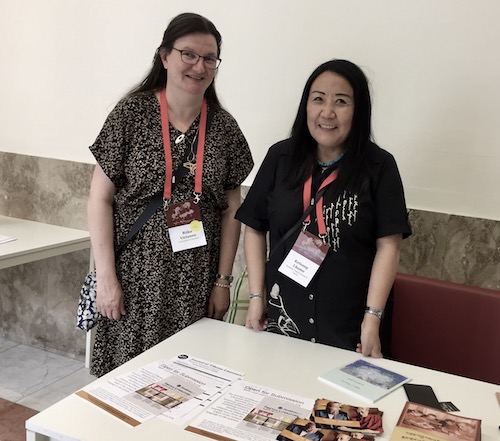
Kelsang Lhamo and Riika Virtanen at Charles University in Prague, summer 2022.
The First Published Book: “Dreaming at the Sage’s Abode”
Next we talked about Kelsang Lhamo’s first book and her life during its writing and publication. Her first book was written in India in Dharamshala. Kelsang Lhamo was still very young when she arrived in India from Tibet, being only sixteen years old. In the beginning she did not plan to stay in India, as she had only wished to see the Dalai Lama and Bodhgaya and then return back to her home region after the end of her holiday. But that did not happen. Seeing the Dalai Lama inspired her to become a nun.
In Dharamshala, Kelsang Lhamo lived in a house called Rishibhavan with some other nuns, and read and wrote a lot. She tells that she always wished to become a writer. Her first book Dreaming at the Sage’s Abode (Drang srong bsti gnas kyi rmi lam yun cig) was published by the Amnye Machen Institute in 1999. The book includes the stories of four nuns. In email messages with Kelsang Lhamo I had learned earlier that those are based on real-life stories, although the names of some of the nuns have been changed. Kelsang Lhamo spoke about the stories of nuns included in her book. The story of Pelmo (dPal mo) in the book is the life story of her late best friend. She wanted to write it because she felt that it was very special. She characterized the story of this friend as incredible and its main protagonist as very authentic and innocent. She told that when she thinks of this friend’s life, she feels deep sadness and joy at the same time.
Kelsang Lhamo described the life story of each nun in her book as being very remarkable. Sometimes she is asked why she chose just those nuns, and she tells that she holds the life stories of these nuns in particular to be deeply touching, even if it is true that each person has a story. Kelsang Lhamo commented on one of the stories, that of a nun from a family called Zhakabpa (Zhwa sgab pa), explaining that this nun had a very pleasant life when she was young but it was very difficult at the end. This was because she had become a nun; although the Zhakabpa family was quite large, when she became old no one took care of her, and her life was very lonely. Earlier, before she came to India, she had been in prison. Kelsang Lhamo added that it is sad to think about the difficulties that this nun experienced.
Kelsang Lhamo told that when she wrote her first book, she had not made a plan to do that or that it would be published someday. When she was in retreat at the Rishibhavan house, she wrote the stories of the nuns in notebooks and then just put them to the side. Because of the help she received from Pema Bhum and Tashi Tsering, that book was eventually published. At her place of retreat, there were also some students from Amdo. Kelsang Lhamo tells that there was also a person called Dorje Tsering, who brought Pema Bhum there. He then talked about Kelsang Lhamo’s writing with Tashi Tsering, who was working at the Amnye Machen Institute, which published books and a journal. Kelsang Lhamo remembered that those Tibetans who had recently arrived from Tibet felt close to each other, since they were so few at that time.[3]
Literary Models and Influences: Inspiration from the Tibetan Tradition
In order to understand more about the literary influences on Kelsang Lhamo’s writing, I asked about her literary models and sources of inspiration. We talked about books that have been important for her. She shared that she loves Peljor’s (dPal ’byor) novel gTsug g.yu (“The Turquoise Head Ornament”), which she brought from Tibet with her. When she traveled to India from Tibet, she had the songs of Milarepa, gTsug g.yu and Dragdong Treling Wangdor’s (Brag gdong bKras gling dbang rdor) novel bKras zur tshang gi gsang ba’i gtam rgyud (The Secret Tale of Tesur House). She carried them with her on the snowy mountains, and when she had to throw something away due to weight, she always discarded other things, like blankets and tsampa, but kept carrying the books. I told her that I have read those books and that they made a big impression on me, too.[4] Hearing how important the Sixth Dalai Lama’s songs were to Kelsang Lhamo in her youth, I asked if she had carried those songs with her as well. She replied that Tibetans always learn them by heart. Earlier those songs did not exist in written form, but people went to the countryside to collect them and then the songs were published together.
As an important source of inspiration, Kelsang Lhamo mentions Tsangnyon Heruka (gTsang smyon he ru ka), the writer of Milarepa’s biography. He wrote the life story of Milarepa 400 years after Milarepa lived in Tibet. Kelsang Lhamo explained that because of Tsangnyon Heruka’s work, Milarepa has become really well known. She describes the writing style of Tsangnyon Heruka as very deep, clear and meaningful. Words are so well chosen that not even a single one can be left out. Kelsang Lhamo was 12 years old when she read the life story of Milarepa written by Tsangnyon and learned it by heart. When the women gathered together in her native region, she told them the story of Milarepa. Kelsang Lhamo tells that she recently read the life story of Tsangnyon again, because she wanted to check a certain detail in it.
At Mount Kailash
Earlier, I noticed an interesting bit of information in Kelsang Lhamo’s profile on the BDRC website. There was mention of a work of poetry named “A Maiden’s Wandering Westward.” When I asked her about it through email, I got a reply that it had not yet been published. Later Kelsang Lhamo wrote me that she has over 300 short poems in her drawer. During our interview, Kelsang Lhamo discussed that literary work about wandering westward. Initially she traveled from Tibet to Nepal, and then from there went to India and from India again to America, where she has already lived 22 years. We talked about how interesting it would be if she could publish at least something from that early literary work. Among those poems are also ones that Kelsang Lhamo considers suitable for publishing, which were written at Mount Kailash. She returned in her memories to Mount Kailash, where she traveled after leaving school when only 15 years old. She stayed there for about three months and wrote a lot then. She reminisced how beautiful it was—at that time there were no tourists yet, contrary to today—and commented that if she looks at how she was writing in the 1980s and 1990s, her style of writing has not changed that much, except perhaps in regard to personal experiences, where her writing these days is a bit more in depth. Kelsang Lhamo explained that it could be time to publish her earlier works when she completes the task of writing the biography of E. Gene Smith.[5] During the conference the attendees got to see a proof of his life story, which she was checking before publication. She has written that book in Tibetan, and the English-language version is currently being developed, together with a translator.
About Writing
When we talked about writing, I asked how she goes about it. She answered that she writes with both pen and laptop, but using the latter started only in 2005 in America. She writes nearly daily, and she always keeps notebooks and also reads a lot of books. Sometimes it happens that she sees very interesting poems, which she adds to her notebook. She then tries to write in the same kind of style, describing it like learning to write, with those poems functioning as examples. She used the term dper brjod (“example”), which describes when Tibetans study poetry and the students write their own verses but follow the model of different verses. She does not read English poetry, as it still does not appeal to her feelings in the same way as texts written in her mother tongue. However, she has become acquainted with some English songs, like “Country Road,”[6] which she sometimes listens to and enjoys.
I asked Kelsang Lhamo what her advice might be for people who feel interested in writing. She advises them to choose from a larger amount of writings those that are suitable for publishing, because if one plans from the beginning to write something for publication, then it will not be authentic. She shared that she always writes what she thinks, and then she chooses later what will happen. If someone says that a certain piece of writing is good and that she should publish it, then she may consider it.
I asked what she thinks about life in the US. Kelsang Lhamo replied that life in the US is good and wonderful, citing as a special reason that there are a lot of types of social media. I was surprised at this and asked if she likes social media. She mentioned Facebook and WeChat. If it has been a day that has felt special, she shares some of her poems there. On Facebook she posted only in Tibetan, but she stopped a few years back because it took so much of her time. These days she sends her poems to her friends in letters. I myself had the honor to receive some in her emails, often accompanied by a beautiful picture.
(Riika J. Virtanen)
Translations of two poems by Kelsang Lhamo “Ganden Ngachoe” (dGa’ ldan lnga mchod) and “Please Give Me Your Blessing!” (dNgos grub cig gnongs shig) are also published in this blog. You may read them here.
Notes
1. The webpage of the BDRC can be found at https://www.bdrc.io/ (accessed November 16, 2022.)
2. My translations of Kelsang Lhamo’s poems into Finnish remain unpublished, with the exception of the two poems published here, found in a Finnish version of this blog.
3. When I was staying in Dharamshala in the 1990s, there were Tibetans who had arrived much earlier and their descendants and then a group of Tibetans who had arrived quite recently. They were sometimes referred to with the expression gsar ’byor, meaning “new arrivals” or “those who had recently arrived.”
4. I have previously written about the two latter books. See Riika J. Virtanen, “Characters in Modern Tibetan Fiction Set in Pre-1950s Central Tibet: Aristocrats, Common Folk and Others,” Revue d’Etudes Tibétaines, no. 37 (December 2016): 490–514 (http://www.digitalhimalaya.com/collections/journals/ret/index.php?selection=8).
5. Kelsang Lhamo’s life story of E. Gene Smith was published in the beginning of 2023.
6. John Denver’s “Take Me Home, Country Roads” (1971).
Kelsang Lhamon runot “Ganden ngachö” ja “Suokaa minulle siunauksenne!”
Runoista ja käännöksistä
Suomen Himalajan-tutkimuksen seuran blogissa julkaistaan suomennokset Kelsang Lhamon kahdesta runosta. Runojen kirjoittaja Kelsang Lhamo on kotoisin Lhokha-nimiseltä alueelta Tiibetistä, joka sijoittuu pääkaupungista Lhasasta kaakkoon. Tällä hetkellä hän asuu ja työskentelee kirjastonhoitajana Bostonissa, Amerikassa. Hän on aiemmin julkaissut nunnien elämään pohjautuvan kertomuskokoelman “Uneksuntaa Askeettien talossa”, toisen elämäkertateoksen erään buddhalaisen mestarin elämästä sekä runoja. Hän on myös kirjoittanut E. Gene Smithin elämäkerran, joka ilmestyi alkuvuodesta 2023. Kaksi tässä suomennoksina julkaistavaa runoa on ilmestynyt Pelmon (dPal mo) toimittamassa tiibetiläisten naisrunoilijoitten kirjoituksia sisältävässä kirjassa nimeltä bZho lung, joka ilmestyi vuonna 2005 Beijingissä Kansallisuuksien painon julkaisemana.
Ensimmäisen runon otsikko “Ganden ngachö” viittaa buddhalaiseen pyhäpäivään, joka ajoittuu tiibetiläisen kalenterin 10. kuun 25. päivälle. Pyhäpäivän vietolla kunnioitetaan Tiibetin buddhalaisuuden kehityksen kannalta merkittävän elämäntyön tehneen ja kirjallisen tuotannon luoneen lama Tsongkhapan (1357–1419) muistoa ja hänen kuolemansa vuosipäivää yli 600 vuotta sitten. Hän perusti tunnetun Ganden-luostarin Lhasassa. [1] Ganden ngachön vietolle on tyypillistä, että illalla joka puolelle, luostareissa, temppeleissä, ja yksityiskodeissa ja pihapiireissä tiibetiläiset sytyttävät suuren määrän voilamppuja sekä resitoivat dMigs rtse ma:ksi kutsuttua rukousta eli “Äärettömän rakkauden” viiden säkeen rukousta lama Tsongkhapalle.
Toisen runoista “dNgos grub cig gnongs shig” (“Suokaa minulle siunauksenne”) ajatusmaailma on saanut inspiraatiota buddhalaisuudesta ja sen eräästä keskeisestä opista, tarpeesta vapautua kärsimyksestä ja yhä uusien jälleensyntymien kierrosta. Runo on kirjoitettu New Yorkissa ja siinä heijastuu myös länsimaahan – Yhdysvaltoihin – muuttamisen vaikutus sen kirjoittajan ajatusmaailmaan.
Tiibetiksi luettuina runot ovat hyvin rytmisiä. Runo “Ganden ngachö” on rakenteeltaan säännöllistä 9-tavua per rivi mittaa noudattava 6-stanzainen eli säkeistöllinen runo. Toinen runo “Suokaa minulle siunauksenne” on 9 stanzan mittainen mitallinen runo, joka noudattaa säännöllistä 11-tavua per rivi mittaa. Tämä mitallisuus ja säännöllinen rytmi ei valitettavasti tule ilmi suomenkielisissä käännöksissä, joissa suomentaja on yrittänyt tulkita runojen merkityksiä ja sisältöä ja säilyttää stanza-rakenteen, mutta mitallisia rakenteita hän ei onnistunut tuottamaan käännöksessään johtuen suomenkielen ja tiibetinkielen hyvin erilaisesta rakenteesta.
Ganden ngachö
Kelsang Lhamo
Öljyisen rasvaisina kiiltelevien voilamppujen valaisema pihapiiri näytti kauniilta
“Äärettömän rakkauden” rukouksen mutinasta kajahtelevien porttien pielessä oli ihanaa
nuudelikeiton valmistuksessa taitavan äitini kasvot sädehtivät hellyyttä
muistelen Ganden ngachön viettoa rakkaitten vanhempieni luona.
Korskean nuoruuden täyttämät tietoisuudet huumaantuneina
oluenjuonnista, lauluista ja vapaasta ilonpidosta
huolimatta paheellisuudesta kuinka hauskaa kaikki olikaan
muistelen Ganden ngachön viettoa ikäisteni nuorten joukossa.
Paikassa, jossa vuoret näyttävät yltävän taivaalle
mestarini harjoittaa aina syvällisiä bodhisattvan käytöksen ohjeita
nauttii askeettisesti puhdasta ravintoa ja omaa rakastavan hyvyyden ohjeistukset
muistelen Ganden ngachön viettoa hyväntahtoisen hengellisen opettajani luona.
Vanhassa Askeettien taloksi kutsutussa taloröttelössä
lauloin aiempien aikojen pyhien mestareiden elämäkertoja
vaikka se olikin majapaikkani, sinä päivänä auringonpaiste lämmitti ihanasti
muistelen Ganden ngachön viettoa aution villiyrttejä kasvavan metsän keskellä.
On pakko kiirehtiä askeleita kuin lennossa
vaikka mieleni ei vielä haluaisi havahtua unesta
ymmärtämättä mikä päivä on käsillä ovat vuodet ja kuukaudet kuluneet
New York Cityn Ganden ngachö-päivä on masentava.
Jonakin päivänä jossakin ihanassa paikassa
henkisten sisarten ja veljien sekä uskollisten ystävien keskuudessa
kunnioittaen buddhia anteliailla lahjoilla
saisinpa pian viettää hyvää ja onnellista Ganden ngachö-päivää!
(New Yorkissa 2005)
Suokaa minulle siunauksenne!
Kelsang Lhamo
Oi viehkeä jumalatar sulan smaragdin sävyiseltä turkoosilehtien kentältä
kaiken tuskan hälvennät sinua vain mielessään muistelevilta
vaikka tämä jatkuva kerjäläisen laulu ei olekaan kovin miellyttävää
ole armollinen ja auta tätä puhdasmielistä uskovaa!
Eilisen luminen hopeisena hohtava maailma
tänään lumen kadottua on yht’äkkiä muuttunut vihreäksi
miettien vuodenaikojen vaihtelua en pystynyt rauhoittumaan
luonnon vuodenaikojen kuningattaren pettävyys on julmaa
Kuvajainen maastani, jossa äitini asustaa
nousee mieleeni vain mielikuvana
ajatellen karman voimaa, en tuntenut mieltäni tyyneksi
menneitten aikojen valaistuneiden mestarien sanat ovat niin tosia!
Vaikka vapauksien ja lahjojen sävyttämä kallisarvoinen ihmiselämä onkin kuin auringonpaiste
pyhän dharman mietiskely sydämessäni muistuttaa pimeää pohjoiseen aukeavaa luolaa
syntyessä yhä uudelleen ja uudelleen elämän kiertokulkuun ei ole rauhaa
verraton hyvä hengellinen mestarini, luo tänne myötätuntoinen katseesi!
Vuoren rinteellä autiossa luolassa, kaukana vihollisista ja ystävistä,
pysyväksi turvakseni ajattelin kahtatoista askeettista harjoitetta
vuosien ja kuukausien vieriessä ilman vakavaa dharman harjoitusta
toiveikkaat rakastavat vanhempani, älkää olko pettyneitä!
Saavuin loistokkaaseen kuuluisaan länteen
dharman harjoittaminen maallisia päämääriä varten on yleinen tapa
pyhän dharman opettaminen välittämättä sen arvosta tuntuu ahdistavalta
tunnustan tämän buddha Shakyamunille mitään salaamatta
Vaikka miettimästä mietin loppuelämääni
sen merkityksettömyys tuntuu vain itkettävältä
pyöreä maailma ilman alkua ja loppua
tunnen itseni rauhattomaksi kuin vettä vuotavassa laivassa
Vaikka tunteita palvellen on kasvoilleni ilmestynyt ryppyjä
mieluista ihanaa paikkaa en vieläkään ole löytänyt
kun kaikki katoaa itsestään kuin sateenkaari
täriseviin sormenpäihini on jäänyt vain lyijykynä
Himalajan alueelta tulevan vaeltajan pyynnön
esitän jumaljoukolle, esteettömästi näkeville
aina myötätuntoiset turvapaikat, Kolme Jalokiveä,
suokaa minulle siunauksenne katkaisemalla huonon karman kierre!
(2004 New Yorkissa)
(Kelsang Lhamon runojen suomennokset tiibetistä sekä esittelyteksti: Riika J. Virtanen)
Viite
1. Tietoa Tsongkhapa Lobsang Dragpan (Tsong kha pa Blo bzang grags pa) elämästä ja Ganden ngachö-festivaalin vietosta löytyy seuraavista lähteistä: Richardson 1993: 114 ja Repo 2011.
Lähdeluettelo
dPal mo (toim.) 2005. bZho lung. Beijing: Mi rigs dpe skrun khang.
Richardson, Hugh 1993. Ceremonies of the Lhasa Year. London: Serindia Publications.
Repo, Joona 2011. “Tsongkhapa Lobsang Dragpa” (“Tsong kha pha Blo bzang grags pa”), The Treasury of Lives, https://treasuryoflives.org/biographies/view/Tsongkhapa-Lobzang-Drakpa/8986 (Katsottu 22.10.2020).
sKal bzang lha mo 1999. Drang srong bsti gnas kyi rmi lam yun cig (“Dreaming at the Sage’s Abode: Biographical Sketches of Four Living Tibetan Nuns”. (rTsom rig sgyu rtsal deb phreng 3. Tibetan Literature Series, No 3). Dharamsala: Amnye Machen Institute.
sKal bzang lha mo 2005. “dNgos grub cig gnongs shig”. dPal mo (toim.), bZho lung. Beijing: Mi rigs dpe skrun khang: 47–49.
sKal bzang lha mo 2005. “dGa’ ldan lnga mchod”. dPal mo (toim.), bZho lung. Beijing: Mi rigs dpe skrun khang: 49–50.
sKal bzang lha mo 2016. mKhas zhing grub pa’i dbang phyug dge ba’i bshes gnyen ye shes stobs ldan rin po che’i rnam thar mthong bas don yod (“A Short Biography of Geshe Yeshe Tobden (1928–1999), aka Gen Drubthob Rinpoche). New Delhi: Published by Kelsang Lhamo.
Tiibetiläisen kirjailijan Kelsang Lhamon haastattelu: Inspiraatiota kirjoittamiseen vuosisatojen takaa
Riika J. Virtanen
Konferenssissa Prahassa
Kävin heinäkuussa 2022 Prahassa, koska siellä järjestettiin suuri tibetologinen IATS-konferenssi eli 16. Kansainvälinen Tiibetin tutkimuksen seminaari (the 16th International Seminar of Tibetan Studies). Tuntui ihmeelliseltä ja ihanalta, että pitkän korona-ajan jälkeen saattoi taas kokoontua ihan läsnäolevana oikeassa konkreettisessa paikassa, eli Kaarlen yliopistolla järjestettyyn konferenssiin sen sijaan, että olisi vain istunut kotonaan tuijottamassa ruutua Zoom-tapaamisen aikana. Sen lisäksi, että tapasin monia tutkijakollegoja siellä, oli aivan erityisen upeaa saada tavata tiibetiläinen runoilija Kelsang Lhamo (s. 1973), jonka kanssa olin vaihtanut spostiviestejä, mutta en ollut koskaan aiemmin tavannut oikeassa elämässä.
Tapasin Kelsang Lhamon ensimmäisenä varsinaisena konferenssipäivänä Buddhist Digital Resource Centren (BDRC) pöydän ääressä. Tällä merkittävän digitaalisen kokoelman omaavalla kirjastolla oli infopiste käytävällä konferenssin aikana, jossa tutkijat saattoivat saada neuvoja, miten käyttää sen kokoelmia [1]. Olen kääntänyt suomeksi joitain Kelsang Lhamon runoja [2] ja myös konferenssiesitykseni käsitteli hänen runouttaan, joten oli mahtavaa vihdoin saada tavata tämä Bostonissa asuva runoilija ja kirjailija, joka myös työskentelee BDRC:ssä ja oli sen takia mukana sen tiimissä konferenssissa. Päätimme tavata seuraavana iltapäivänä ja mennä illastamaan yhdessä. Saisin myös haastatella häntä. Seuraavana päivänä menimme syömään saman kadun varrella sijaitsevaan intialaiseen ravintolaan ja sain esittää hänelle kysymyksiä.
Varhaisia vaikutteita VI dalai-laman Tshangyang Gyatson lauluista
Haastatellessani häntä, Kelsang Lhamo toi esiin, kuinka paljon hän on saanut vaikutteita ja inspiraatiota traditionaalisesta tiibetiläisestä kirjallisuudesta. Tuntui, että tämä tällä hetkellä Amerikassa Bostonissa elävä tiibetiläinen kirjailija ja runoilija ei niinkään ole hyödyntänyt länsimaiden tiibetiläisestä kulttuurista kovin poikkeavaa kulttuuria inspiraation tai tiibetiläisen tradition uudistamisen lähteenä, vaan tietoisesti kääntyy omaan traditioonsa päin hyödyntäen sen tyylikeinoja. Hän on alunperin kotoisin Lhokhasta Tiibetistä (Tiibetin autonomiselta alueelta) melko pienestä paikasta Gongkarin (Gong dkar) alueella, jonka lähellä on Ling Repan (gLing ras pa) retriittikeskus nimeltä “Naphug” (gNa’ phu ri khrod) sekä Dorje Drag (rDo rje brag) niminen luostari.
Kyselen miten Kelsang Lhamo aloitti kirjoittamisen ja hänen ensimmäisistä kirjoituksistaan. Hän aloitti kirjoittamaan varsin varhain, noin 12-13 vuotiaana. Tuolloin hän piti erityisesti VI dalai-laman Tshangyang Gyatson (Tshangs dbyangs rgya mtsho) lauluista. Niitä on julkaistu painettuna, mutta Kelsang Lhamo kuuli niitä nuorena vanhemmiltaan ja muilta kotiseutunsa ihmisiltä, jotka lauloivat niitä. Naiset saattoivat laulaa niitä jopa jonkinmoisena “kilpailuna” niin, että lauloivat vuorotellen ja jotkut heistä jopa keksivät omia laulujaan. Myös Kelsang Lhamo alkoi sekä laulaa että kirjoittaa omia laulujaan, mutta näitä varhaisia lauluja ei vielä tuolloin julkaistu. Hän kertoo oppineensa ulkoa satoja lauluja ja kirjoittaneensa omiaan samalla tyylillä.
Kun Kelsang Lhamo oli noin 14-vuotias, hän sai mahdollisuuden osallistua kirjallisuuslehti “Lhokhan kirjallisuus” (Lho kha rtsom rig sgyu rtsal) järjestämille luennoille, joilla oli opettajana Dungkar Losang Thrinley (Dung dkar blo bzang phrin las) sekä muita lamoja. Dungkar Losang Thrinley opetti runoutta. Hän on kirjoittanut kommentaarin intialaiseen tiibetiksi käännettyyn runouden klassikkoteokseen Dandinin Kāvyādarśaan. Kelsang Lhamo kommentoi, että mahdollisuus opiskella kirjallisuutta auttoi myös kehittämään hänen omia kirjoitustaitojaan.
Ensimmäinen julkaistu kirja “Uneksuntaa Askeettien talossa”
Seuraavaksi juttelemme Kelsang Lhamon ensimmäisestä kirjasta ja hänen elämästään sen kirjoittamisen ja ilmestymisen aikoihin. Ensimmäinen kirja syntyi Intiassa Dharamsalassa. Kelsang Lhamo oli vielä hyvin nuori saapuessaan Intiaan Tiibetistä, vain 16-vuotias. Hänen ei aluksi ollut tarkoitus jäädä Intiaan vaan hän oli toivonut näkevänsä Dalai-laman ja Bodhgayan ja sitten palaavansa takaisin kotiseudulleen koulun loman loputtua. Näin ei kuitenkaan käynyt. Dalai-laman näkeminen antoi hänelle inspiraatiota ruveta nunnaksi.
Dharamsalassa Kelsang Lhamo asui Rishi Bhavan nimisessä talossa joidenkin muiden nunnien kanssa ja luki ja kirjoitti paljon. Hän kertoo aina halunneensa kirjailijaksi. Siellä syntyi hänen ensimmäinen kirjansa “Uneksuntaa Askeettien talossa” (Drang srong bsti gnas kyi rmi lam yun cig). Amnye Machen instituutti julkaisi sen vuonna 1999. Se sisältää neljän nunnan tarinat. Olen jo aiemmin kuullut Kelsang Lhamolta hänen lähettämässään viestissä, että tarinat ovat todellisuuspohjaisia, vaikka osassa nunnien nimiä on muutettu. Kelsang Lhamo puhuu nunnien tarinoista, jotka hän on kirjoittanut tuohon teokseen. Teoksessa olevan Pelmon (dPal mo) tarina on hänen parhaan jo edesmenneen ystävänsä elämäntarina. Hän halusi kirjoittaa sen, koska hän koki tämän ystävän elämäntarinan hyvin erityisenä. Hän luonnehtii tämän ystävän tarinaa uskomattomana ja sen päähenkilöä hyvin autenttisena ja viattomana persoonana. Kun hän ajattelee tämän ystävän elämää, hän kertoo tuntevansa sekä syviä surun että ilon tunteita.
Kirjailija luonnehtii jokaisen nunnan elämäntarinaa teoksessa hyvin merkittäväksi. Joskus häneltä on kysytty, miksi hän valitsi juuri nuo nunnat? Hän kertoo pitäneensä juuri näiden nunnien elämäntarinoita syvästi koskettavina, vaikka on totta, että jokaisella ihmisellä on tarina. Kelsang Lhamo kommentoi vielä yhtä tarinoista, joka on Zhakabpa (Zhwa sgab pa) nimisestä perheestä olevan nunnan tarina. Hän selittää, että tuo nunna sai nuoruudessaan nauttia jopa ylellisestä elämästä, mutta myöhemmin hänen vanhetessaan hänen elinolosuhteensa olivat hyvin vaikeat. Tämä johtui siitä, että hän oli ruvennut nunnaksi ja vaikka Zhakabpan perhe on hyvin suuri, kukaan ei hänen tullessaan vanhaksi huolehtinut hänestä. Hänen elämänsä oli hyvin yksinäistä. Aiemmin, ennen Intiaan tuloaan, hän oli ollut vankilassa. Kelsang Lhamo kommentoi, että on surullista ajatella tämän nunnan kokemia vaikeuksia.
Kirjoittaessaan teosta, Kelsang Lhamo kertoo, ettei hän ollut tehnyt mitään etukäteissuunnitelmaa kirjan kirjoittamisesta tai että se julkaistaisiin jonain päivänä. Ollessaan retriitissä Rishibhavan nimisessä talossa hän kirjoitteli nunnien tarinoita muistikirjoihinsa ja laittoi sitten ne vain syrjään. Teos päätyi julkaistavaksi Pema Bhumin ja Tashi Tseringin ansiosta. Retriittipaikassa oli ollut myös joitain opiskelijoita Amdosta. Kelsang Lhamo kertoo Dorje Tsering nimisen henkilön olleen myös siellä ja tuoneen paikalle Pema Bhumin. Tämä kertoi asiasta Tashi Tseringille, jolla oli vaikutusvaltaa Amnye Machen -nimisessä instituutissa, joka julkaisi kirjoja ja myös lehteä. Kirjailija kommentoi, että äskettäin Tiibetistä tulleet tiibetiläiset tunsivat itsensä läheisiksi toisilleen koska heitä oli sen verran vähän siihen aikaan [3].
Kirjallisia malleja ja vaikutteita: esikuvia ja inspiraatiota tiibetiläisestä traditiosta
Ymmärtääkseni enemmän Kelsang Lhamon saamista kirjallisista vaikutteista kyselen hänen kirjallisista esikuvistaan ja inspiraationsa lähteistä. Keskustelemme kirjoista, jotka ovat olleet hänelle tärkeitä. Hän kertoo rakastavansa Peljorin (dPal ’byor) romaania gTsug g.yu (“Turkoosipääkoriste”) ja oli tuonut sen Tiibetistä mukanaan. Kun hän matkasi Intiaan Tiibetistä, hänellä oli mukanaan Milarepan laulut, gTsug g.yu ja Dragdong Treling Wangdorin (Brag gdong bKras gling dbang rdor) romaani bKras zur tshang gi gsang ba’i gtam rgyud (The Secret Tale of Tesur House, “Tesurin talon salainen tarina”). Hän kantoi niitä mukanaan lumivuorilla ja kun täytyi heittää jotain pois painon takia, hän heitti muita tavaroita kuten huopia tai tsampaa, mutta säilytti kirjat kantaen niitä mukanaan. Kerron hänelle itsekin lukeneeni kyseiset teokset ja että ne olivat tehneet vaikutuksen myös minuun [4]. Koska olin juuri kuullut, kuinka tärkeitä VI dalai-laman laulut olivat Kelsang Lhamolle hänen lapsuudessaan, kyselin eikö mukana ollut myös sitten kyseisiä lauluja? Tähän hän vastasi kertoen, että tiibetiläiset aina opettelevat ne ulkoa. Aiemmin lauluja ei ollut kirjoitetussa muodossa, mutta ihmiset menivät keräämään niitä maaseudulle ja sitten laulut koottiin yhteen.
Tärkeänä inspiraation lähteenään Kelsang Lhamo mainitsee Tsangnyön Herukan (gTsang smyon He ru ka), Milarepan elämäkerran kirjoittajan. Hän kirjoitti Milarepan elämäkerran 400 vuotta jälkeen sen ajan, jolloin Milarepa eli Tiibetissä. Kelsang Lhamo kommentoi, että Tsangnyön Herukan kirjoitustyön ansiosta Milarepa on tullut todella tunnetuksi. Hän kuvailee Tsangnyön Herukan kirjoitustapaa todella syvällisenä, selkeänä ja merkityksellisenä. Sanat ovat niin hyvin valittuja, ettei yhtäkään voi jättää pois. Kelsang Lhamo oli 12-vuotias kun hän luki Tsangnyönin kirjoittaman Milarepan elämäkerran opetellen sen ulkoa. Kun naiset kokoontuivat yhteen hänen kotiseudullaan, hän kertoi heille Milarepan tarinaa. Kelsang Lhamo kertoo haastattelua edeltäneellä viikolla lukeneensa uudelleen Tsangnyönin elämäkerran, koska halusi tarkistaa erään seikan siinä.
Kailash vuorella
Aiemmin mielenkiintoni herätti Kelsang Lhamon profiilissa BDRC:n sivuilla ollut maininta runoteoksesta, jonka nimeksi oli mainittu “A Maiden’s Wandering Westward”. Olin kysellyt siitä myös spostitse, mutta olin saanut vastauksen, että sitä ei ole vielä julkaistu. Myöhemmin sain spostiviestissä tiedon kirjailijalta, että hänellä on pöytälaatikossa yli 300 lyhyttä runoa. Haastattelussa Kelsang Lhamo selitti kyseessä olevan juuri tuo teos vaelluksesta länteen. Hän oli ennen Amerikkaan saapumistaan matkannut ensin Tiibetistä Nepaliin ja sieltä Intiaan ja Intiasta edelleen Amerikkaan, missä hän on nyt asunut jo 22 vuotta. Juttelemme siitä, kuinka kiinnostavaa olisi, jos Kelsang Lhamo voisi julkaista jotakin – edes osan – tuosta teoksesta. Hän selittää, että sitten voi olla sen aika, kun hän on ensin saanut elämäkertatyönsä E. Gene Smithin elämästä täysin valmiiksi [5]. Noiden runojen joukossa on myös Kailash-vuorella syntyneitä runoja, joiden Kelsang Lhamo ajattelee olevan sellaisia, että ne voisivat sopia julkaistaviksi. Kelsang Lhamo palaa muistoissaan Kailash-vuorelle. Hän oli jättänyt koulunsa ja lähtenyt Kailash-vuorelle ollessaan 15-vuotias. Hän oleskeli siellä noin kolme kuukautta ja kirjoitti silloin paljon. Hän muistelee, kuinka kaunista silloin olikaan Kailash-vuorella. Silloin ei siellä vielä ollut turisteja, toisin kuin nykyään. Hän kommentoi, että jos hän tarkastelee, miten hän kirjoitti 80- ja 90-luvulla, hänen kirjoitustyylinsä ei ole paljonkaan muuttunut. Paitsi ehkä kokemuksien suhteen: nykyään kirjoitus on hieman syvällisempää. Konferenssin aikana saimme nähdä hänellä tarkistettavana olleen painon oikovedoksen E. Gene Smithin elämäkerrasta, jonka hän on kirjoittanut tiibetiksi. Haastattelun aikana hän kertoi yrittävänsä saada englanninkielistä versiota kuntoon yhdessä sen kääntäjän kanssa.
Kirjoittamisesta
Puhumme kirjoittamisesta. Kyselen, miten hän kirjoittaa? Hän kertoo kirjoittavansa sekä kynällä ja läppärillä. Viime mainitulla kirjoittaminen alkoi vasta vuonna 2005 Amerikassa. Hän kirjoittaa lähes päivittäin ja säilyttää aina muistikirjansa ja lukee myös paljon kirjoja. Joskus käy niin, että hän näkee hyvin kiinnostavia runoja. Silloin hän saattaa jäljentää ne talteen muistikirjaansa ja sitten yrittää kirjoittaa samantapaisella tyylillä. Se on kuin opiskelisi kirjoittamista. Kuin tuo jäljennetty runo toimisi esimerkkinä. Hän käyttää termiä dper brjod, jota käytetään tiibetiläisessä runouden opiskelussa sille, kun opiskelijat kirjoittavat omia säkeitään mutta ottaen mallia erilaisista tavoista rakentaa säkeitä. Olen aiemmin saanut vastaanottaa Kelsang Lhamolta erään hindinkielisen runon, jonka hän oli kääntänyt tiibetiksi. Mutta englanninkielistä runoutta hän ei lue – hän kertoo, ettei se vieläkään vetoa hänen tunteisiinsa samalla tavoin kuin hänen äidinkielellään kirjoitetut tekstit, mutta joihinkin englanninkielisiin lauluihin hän on tutustunut. Hän mainitsee laulun “Country Road” [6], josta hän sanoo nauttineensa.
Kysyn Kelsang Lhamolta, mikä on hänen neuvonsa ihmisille, jotka ovat kiinnostuneita kirjoittamisesta? Kelsang Lhamo neuvoo valitsemaan kirjoituksista sopivia julkaistaviksi. Jos ajattelee kirjoittavansa jotakin julkaisua varten silloin siitä ei tule autenttista. Hän kertoo aina kirjoittavansa mitä ajattelee. Sitten valitsevansa myöhemmin. Jos joku sanoo, että joku kirjoitus on hyvä, ja hänen tulisi julkaista se, silloin hän harkitsee asiaa.
Kyselen vielä mitä Kelsang Lhamo ajattelee elämästä USAssa? Hän vastaa pitävänsä elämää USAssa hyvänä ja ihanana ja mainitsee erityiseksi syyksi sen, koska on paljon sosiaalisia medioita. Hämmästyn ja kysyn pitääkö kirjailija sosiaalisesta mediasta? Hän mainitsee Facebookin ja We Chatin. Jos on erityiseltä tuntuva päivä, hän on laittanut sinne joitain runoja. Facebookiin vain tiibetinkielisiä. Mutta hän lopetti muutama vuosi sitten, koska Facebook vei niin paljon aikaa. Nykyään hän kertoo lähettävänsä runoja kirjeissä ystävilleen. Olen itsekin saanut kunnian vastaanottaa muutamia niistä viesteissä häneltä usein jonkin kauniin kuvan yhteyteen kirjoitettuna.
Blogissa julkaistaan myös Kelsang Lhamon kaksi runoa “Ganden ngachö” (dGa’ ldan lnga mchod) ja “Suokaa minulle siunauksenne!” (dNgos grub cig gnongs shig) käännettynä suomeksi. Runot voi lukea täältä.
Viitteet
1. BDRC:n sivut löytyvät osoitteesta: https://www.bdrc.io/ (Katsottu 16.11.2022.)
2. Muut suomennokseni Kelsang Lhamon runoista ovat vielä toistaiseksi julkaisemattomia paitsi tämän blogitekstin yhteydessä julkaistavat suomennokset hänen kahdesta runostaan.
3. Dharamsalassa oli siihen aikaan kun oleskelin siellä 1990-luvulla sekä huomattavasti aiemmin saapuneita tiibetiläisiä sekä heidän jälkeläisiään sekä joukko tiibetiläisiä, jotka olivat saapuneet verrattain äskettäin. Heihin viitattiin joskus ilmaisulla gsar ’byor, “uudet tulokkaat” tai “äskettäin saapuneet”.
4. Olen kirjoittanut näistä teoksista kahdesta viimeeksi mainitusta artikkelissani, joka ilmestyi elektronisessa tieteellisessä lehdessä Revue d’Etudes Tibétaines (no. 37, December 2016: 490-514): ”Characters in Modern Tibetan Fiction Set in Pre-1950s Central Tibet: Aristocrats, Common Folk and Others” (webaddress:
http://www.digitalhimalaya.com/collections/journals/ret/index.php?selection=8).
5. Kelsang Lhamon kirjoittama E. Gene Smithin elämäkerta julkaistiin alkuvuodesta 2023.
6. Kyseessä on John Denverin laulu “Take Me Home, Country Roads”.
 Suomen Himalajan-tutkimuksen seura (2007–2025)